


 17/03/2026
International Academic Cooperation as a Driver of Modern Philological Science
In the context of the globalization of education, international cooperation between higher education institutions has become one of the key factors in enhancing the quality of education, advancing research, and fostering intercultural academic dialogue. Universities that actively build partnerships with domestic and international academic and research centers are able to broaden their academic scope, adopt advanced educational practices, and promote the academic mobility of faculty and students.
In this regard, Aktobe Regional University named after K. Zhubanov consistently implements a strategy aimed at expanding international academic cooperation with leading educational institutions. The University actively maintains partnerships with both national and international universities, contributing to the integration of Kazakhstan’s science and education into the global academic community.
On July 23, 2023, a memorandum of understanding was signed between Aktobe Regional University named after K. Zhubanov and St. Petersburg State University. The agreement provides for the development of academic partnerships, the exchange of research experience, and the organization of joint educational activities.
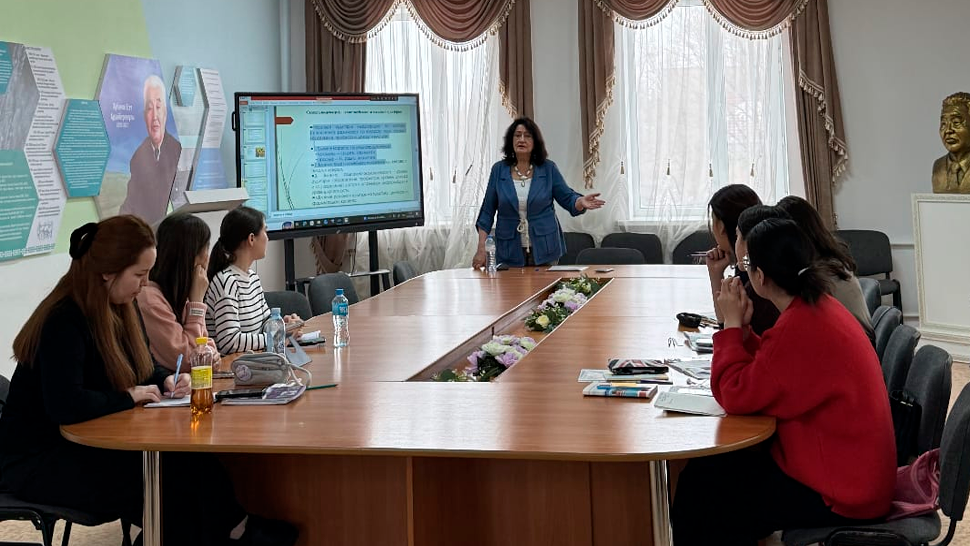
As part of this collaboration, Lyudmila Vladimirovna Balakhonskaya, Candidate of Philological Sciences and Associate Professor in Public Relations in Business, was invited as a visiting scholar to the Department of Russian Philology and Intercultural Communication at the Faculty of Philology. Her visit aims to strengthen academic cooperation between the universities and to develop modern направления in philological and communication studies.
From March 2 to March 13, 2026, a series of academic events was held with her participation, including lectures on the course “Sociology and Psychology of Mass Communications,” practical sessions, and masterclasses for undergraduate and graduate students, as well as academic interaction with faculty members.
Particular attention was given to contemporary approaches to studying mass communication, the mechanisms of public opinion formation, and the role of media in modern society.
Lyudmila Balakhonskaya’s research and teaching activities focus on media communications and the modern communication environment. Her work explores the functioning of mass communication, media discourse, and the interaction between society and the information space. Her teaching is aimed at developing students’ analytical skills necessary for understanding contemporary communication processes.
The involvement of an international scholar in the educational process contributes not only to expanding students’ academic perspectives, but also to the exchange of scientific and methodological approaches between faculty members. Such initiatives facilitate the implementation of modern educational technologies, the improvement of curricula, and the strengthening of international academic ties.